
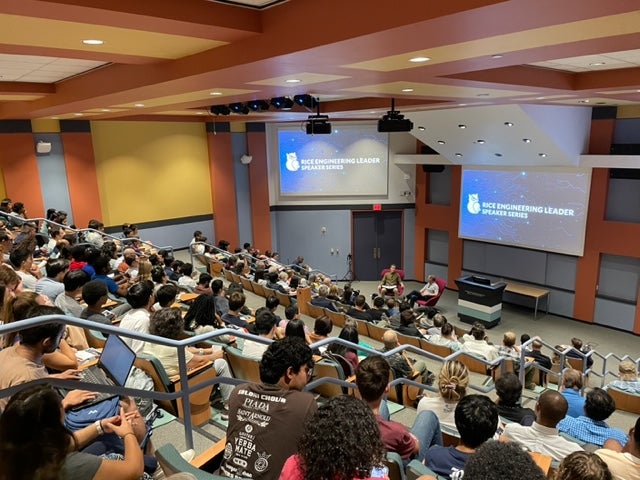
The Rice Center for Engineering Leadership (RCEL) was honored to host Jim Whitehurst ’89, both the former president and CEO of Red Hat, the world’s leading provider of open-source software solutions and the former COO of Delta Airlines, as part of the Rice Engineering Leadership Speaker series on September 12 at Rice University.
Whitehurst spoke to how engineers can prepare themselves to lead and thrive in challenges. He shared his journey from Rice engineering student to Chief Operating Officer of Delta Air Lines, President and Chief Executive Officer of Red Hat, and President of IBM, as well as the transformations he has led along the way. RCEL is grateful to mr. Whitehurst for sharing his insights and experiences with our students and community. We also thank our student moderator, Theo Schweitzer, senior in computer science , for leading the conversation.
ABOUT Jim Whitehurst
Jim Whitehurst '89 joined Delta Air Lines as Chief Operating Officer on September 11, 2001, and successfully steered the company through the shock of 9/11, financial restructuring, and hostile takeover attempts by rival airlines. As President and CEO of Red Hat, Whitehurst grew the Linux software firm into the world’s first billion-dollar open-source company, increasing revenue eightfold and ultimately engineering Red Hat’s $34 billion acquisition by IBM. Under his leadership, Red Hat was named to Forbes’ World’s Most Innovative Companies list, and Barron’s named him one of the World’s Best CEOs.
______
RICE ENGINEERING LEADER SPEAKER SERIES – a leading engineer’s perspective Hosted by the Rice Center for Engineering Leadership, the Rice Engineering Leader Speaker Series features executives and thought leaders from technology organizations who uniquely employ or depend on engineers. These accomplished leaders share experiences in navigating change and how engineers can equip themselves to lead the way. Through this series, the Rice and Houston communities learn about how products and workplaces are being disruptively transformed through technological advancements, and how engineers will be expected to not just adapt to but lead this transformation.